The Importance of Professional Cleaning in Healthcare Facilities

The Importance of Professional Cleaning in Healthcare Facilities

Healthcare facilities are different from regular commercial buildings. Whether it is a primary care clinic, urgent care center, emergency room, imaging center, specialty practice, or multi-location medical office, cleanliness directly affects patient safety, staff confidence, infection prevention, and the overall quality of care.

Patients visit medical facilities when they may already be sick, injured, immunocompromised, or at higher risk for infection. At the same time, doctors, nurses, technicians, and front-desk teams move through shared spaces throughout the day. This makes healthcare cleaning more than appearance. It is a structured process designed to reduce risk, support infection control, and maintain a safe environment for everyone inside the facility.

Why Cleaning Matters in Medical Environments

In healthcare settings, germs can spread through high-touch surfaces, contaminated equipment areas, bodily fluids, respiratory droplets, waiting-room traffic, restrooms, exam rooms, and shared workspaces. A surface may look clean but still carry bacteria, viruses, or other contaminants if the correct cleaning and disinfecting process is not followed.

For facilities such as urgent cares, emergency rooms, and outpatient clinics, the challenge is even greater because patient flow can be unpredictable. One room may be used for a routine visit, the next for a patient with flu-like symptoms, and the next for wound care or urgent treatment. Cleaning protocols must be consistent enough for daily use but flexible enough to respond to higher-risk situations.

A strong cleaning program helps:

  • Reduce the risk of infection spread
  • Create a safer environment for patients and staff
  • Support compliance with healthcare standards and expectations
  • Improve patient trust and comfort
  • Protect the reputation of the facility
  • Extend the life of flooring, furniture, and surfaces
  • Reduce odors, dust, and visible contamination
  • Help staff focus on patient care instead of facility concerns

Cleaning vs. Disinfecting: Understanding the Difference

One of the most important concepts in healthcare cleaning is understanding the difference between cleaning and disinfecting.

Cleaning removes dirt, dust, organic matter, and visible soil from surfaces. This step is essential because disinfectants may not work properly if a surface is still dirty.

Disinfecting uses an approved chemical product to kill or inactivate certain germs on a surface. Disinfectants must be used correctly, including proper dilution, contact time, surface compatibility, and safety precautions.

In healthcare settings, cleaning and disinfecting should not be treated as the same task. In many cases, surfaces must be cleaned first and then disinfected. Skipping the cleaning step, using the wrong product, wiping too quickly, or failing to allow the required dwell time can reduce the effectiveness of the entire process.

Areas That Require Special Attention

A healthcare facility should be cleaned with a risk-based approach. Not all areas carry the same level of exposure, and not all surfaces need the same frequency or type of cleaning.

1. Waiting Rooms and Reception Areas

Waiting rooms are high-traffic spaces where patients, family members, delivery personnel, and staff come together. Chairs, armrests, check-in counters, pens, clipboards, tablets, door handles, and payment terminals are touched repeatedly throughout the day.

These areas should be cleaned regularly and disinfected frequently, especially during cold, flu, COVID, or other respiratory illness seasons. Floors should be kept clean and dry to reduce slip hazards, and trash should be removed before it overflows.

2. Exam Rooms

Exam rooms are among the most important areas in a medical cleaning program. Each room may include exam tables, countertops, stools, chairs, medical equipment surfaces, sinks, cabinet handles, light switches, and door handles.

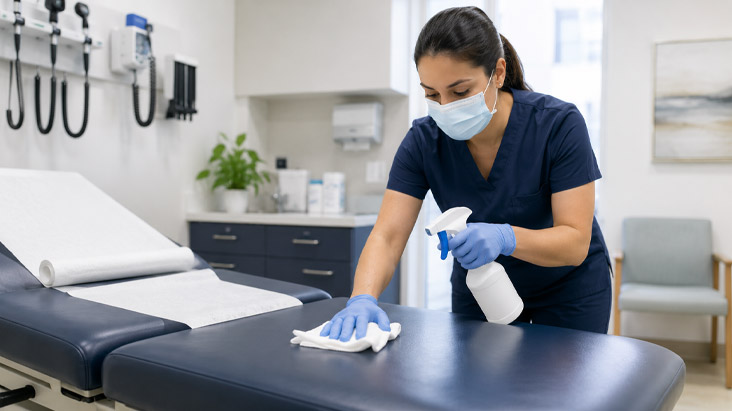
Cleaning between patients is critical. Exam tables, patient chairs, provider work surfaces, and any touched surfaces should be disinfected according to the facility’s protocol. Paper table coverings should be replaced, trash should be removed as needed, and supplies should be restocked without contaminating clean areas.

3. Urgent Care and Emergency Treatment Areas

Urgent care and emergency rooms often handle higher patient volume, faster room turnover, and a wider range of medical situations. These areas require careful attention to blood, bodily fluids, respiratory illness, wound care, vomiting incidents, and other potentially infectious materials.

Cleaning teams must know how to respond safely to spills, isolate contaminated materials, use appropriate personal protective equipment, and disinfect surfaces with products suitable for healthcare environments.

4. Restrooms

Restrooms in healthcare facilities need consistent cleaning and disinfection. Sinks, faucets, toilets, flush handles, grab bars, changing stations, door handles, soap dispensers, and light switches should be treated as high-touch surfaces.

Odor control is also important, but fragrance should never replace proper cleaning. Strong fragrances can bother patients with allergies, asthma, or respiratory sensitivities. A healthcare cleaning program should focus on sanitation, ventilation, and proper product use rather than masking odors.

5. Nurse Stations and Staff Work Areas

Staff areas are often overlooked because they are not always patient-facing. However, nurse stations, keyboards, phones, counters, chairs, shared computers, medication preparation areas, breakrooms, and staff restrooms can become high-touch zones.

Clean staff areas help reduce cross-contamination and support a healthier workplace. Special care should be taken around computers, electronics, charts, supplies, and sensitive documents.

6. Floors and Entryways

Floors in healthcare facilities collect dirt, moisture, debris, and contaminants from outside. Entryways, hallways, exam rooms, and treatment areas should be maintained on a regular schedule. Floor care should be performed with products and methods suitable for the surface type, whether it is vinyl, tile, laminate, sealed concrete, or another healthcare-appropriate flooring system.

Wet floors should be managed carefully to prevent slips. Cleaning teams should use proper signage, avoid blocking patient flow, and schedule deeper floor work during lower-traffic hours whenever possible.

7. Medical Waste and Trash Handling

Medical facilities often generate different types of waste, including regular trash, sharps containers, contaminated materials, and regulated medical waste. Cleaning staff should understand what they are allowed to handle and what must be managed by trained medical personnel or approved waste vendors.

A professional healthcare cleaning company should never treat all waste the same. Waste handling must follow the facility’s procedures and applicable safety requirements.

Important Steps in a Healthcare Cleaning Process

A reliable healthcare cleaning program should be organized, documented, and repeatable. The following steps are important for clinics, urgent care centers, emergency rooms, and similar medical facilities.

Step 1: Evaluate the Facility

Before cleaning begins, the cleaning company should evaluate the facility layout, services provided, patient volume, flooring type, exam room count, restroom count, waiting areas, high-touch surfaces, and any higher-risk zones.

A pediatric clinic, urgent care, imaging center, family medicine practice, and emergency care facility may all need different cleaning plans. The cleaning program should fit the actual use of the facility rather than applying a generic office-cleaning checklist.

Step 2: Create a Site-Specific Cleaning Plan

The cleaning plan should define what gets cleaned, how often it gets cleaned, what products are used, who is responsible, and how quality is checked.

This plan should include:

  • Daily cleaning tasks
  • High-touch disinfection points
  • Exam room turnover support
  • Restroom cleaning frequency
  • Trash and waste handling procedures
  • Floor care schedule
  • Deep cleaning schedule
  • Supply restocking responsibilities
  • Spill response procedures
  • After-hours cleaning needs
  • Documentation and inspection process

A written plan helps create consistency. It also allows facility managers to hold the cleaning provider accountable.

Step 3: Identify High-Touch Surfaces

High-touch surfaces require special attention because they are touched frequently by multiple people. These may include door handles, light switches, armrests, countertops, exam tables, patient chairs, faucet handles, toilet handles, keyboards, phones, touchscreens, payment terminals, clipboards, cabinet handles, elevator buttons, and handrails.

In a healthcare setting, these surfaces should be disinfected more frequently than low-touch surfaces.

Step 4: Use Appropriate Healthcare-Grade Products

Not every cleaning product is appropriate for a medical environment. Disinfectants should be selected based on the types of organisms they are designed to address, the surfaces being treated, manufacturer instructions, contact time, safety data, and compatibility with the facility.

Using the wrong chemical can create several problems. It may fail to disinfect properly, damage surfaces, leave residue, create respiratory irritation, or create unsafe chemical exposure for staff and patients.

Professional healthcare cleaners should understand product labels, dilution requirements, dwell times, and when different products are needed for different areas.

Step 5: Follow Proper Contact Time

Disinfectants require a specific amount of time to remain wet on the surface to work properly. This is often called dwell time or contact time.

One common mistake in non-specialized cleaning is spraying a disinfectant and immediately wiping it away. If the product does not remain on the surface for the required time, it may not perform as intended.

Healthcare cleaning teams should be trained to follow the product label exactly.

Step 6: Prevent Cross-Contamination

Cross-contamination happens when germs are moved from one area to another. This can occur through dirty cloths, mop heads, gloves, carts, buckets, or improper cleaning sequence.

To reduce this risk, cleaning staff should use proper color-coded cloths or area-specific supplies, change cloths frequently, clean from cleaner areas to dirtier areas, and avoid using the same tools in restrooms and clinical areas.

Step 7: Clean in the Correct Order

The order of cleaning matters. A common approach is to clean from high to low, clean to dirty, and dry to wet. This helps prevent re-contaminating areas that were already cleaned.

For example, in an exam room, staff may begin with higher surfaces and equipment touchpoints before moving to lower surfaces and floors. Restrooms should typically be cleaned with separate tools and procedures from patient care areas.

Step 8: Document Completed Work

Documentation is especially important in healthcare cleaning. A cleaning company should be able to provide checklists, logs, inspection forms, and communication notes when needed.

Documentation helps facility managers verify that tasks were completed. It also supports accountability when there are concerns, complaints, inspections, or infection-control reviews.

Step 9: Perform Quality Checks

Cleaning should not rely only on trust. Supervisors should inspect the work, review high-touch areas, check restrooms, verify supply levels, and communicate with facility leadership.

A strong cleaning company will correct issues quickly and adjust the plan when patient volume, hours of operation, staffing, or facility needs change.

Step 10: Schedule Periodic Deep Cleaning

Daily cleaning is important, but healthcare facilities also need scheduled deep cleaning. This may include detailed floor care, baseboards, vents, upholstery, walls, corners, waiting-room furniture, restroom detail work, and areas behind or under movable furniture.

Deep cleaning helps address buildup that routine cleaning may not fully remove.

What to Consider When Choosing a Healthcare Cleaning Company

Choosing a cleaning company for a medical facility should not be based only on price. Healthcare cleaning requires training, experience, consistency, and accountability.

Medical offices, urgent care centers, and clinics in the Houston area should look for a provider with experience in professional healthcare facility cleaning, including high-touch disinfection, restroom cleaning, exam room cleaning, and facility-specific cleaning plans.

Before hiring a cleaning provider, facilities should consider whether the company has experience with healthcare environments, uses appropriate disinfectants, understands contact time, provides a written cleaning plan, carries proper licensing and insurance, trains staff on bloodborne pathogen precautions, understands patient-sensitive environments, provides supervision, responds to urgent cleaning needs, and documents completed work.

A regular commercial cleaning company may be qualified to clean offices, retail spaces, or general buildings, but that does not automatically make them qualified for healthcare cleaning.

Why Licensed and Experienced Healthcare Cleaning Matters

Healthcare facilities need a cleaning partner that understands the responsibility of the environment. A licensed and experienced healthcare cleaning company brings more than labor. It brings systems, training, supervision, safety awareness, and the ability to work within a medical setting.

Better Infection-Control Support

Experienced healthcare cleaners understand that certain areas require more attention, certain surfaces require specific products, and certain incidents require special handling. This helps reduce the chance of missed high-risk areas.

Safer Product Use

Healthcare cleaning companies are more likely to use appropriate disinfectants and follow label instructions. This matters because improper chemical use can affect patients, staff, equipment, and surfaces.

More Consistent Results

Medical facilities need dependable cleaning every day. Experienced providers use checklists, schedules, inspections, and trained staff to reduce inconsistency.

Reduced Liability Risk

A facility that hires an unqualified cleaning company may face issues with safety, contamination, chemical misuse, staff exposure, or poor documentation. A properly insured and experienced provider helps reduce those risks.

Better Staff and Patient Confidence

Patients notice cleanliness. Staff notice cleanliness. A clean facility sends a message that the organization is professional, careful, and committed to safety.

Proper Handling of Sensitive Environments

Medical offices are different from normal offices. Cleaning teams may work around patient information, medical equipment, exam supplies, sharps containers, medication areas, and treatment spaces. Training and professionalism are essential.

Cleaning Is Part of the Patient Experience

Patients may not know the details of a facility’s infection-control program, but they do notice the environment. A clean waiting room, fresh restroom, well-maintained exam room, and organized facility can improve trust before the provider even enters the room.

For healthcare organizations, cleanliness supports both safety and reputation. It shows patients that the facility cares about their health, comfort, and experience.

Final Thoughts

Healthcare cleaning is not just a maintenance task. It is an important part of patient safety, infection prevention, staff protection, and facility operations.

Clinics, urgent care centers, emergency rooms, and other medical facilities should work with cleaning professionals who understand healthcare environments and follow proper cleaning and disinfecting procedures. The right cleaning partner can help create a safer, cleaner, and more professional environment for patients, providers, and staff.

For medical facilities, the goal is not simply to look clean. The goal is to maintain a space that supports health, safety, and confidence every day.


arthritis houston

Arthritis Care In Houston

We tend to think that all family doctors are practically the same; and that any differences that exist are so unimportant that it doesn’t matter whose clinic you end up going to. For certain areas of practice, yes, this may be the case. When you are in need of getting your blood taken, for instance – sure, it doesn’t really matter where you end up going. The services you will get at one clinic will be pretty similar to the services you will get at any other. They will take your blood and then ship it to another company that deals with analyzing it. Often times, two separate clinics end up sending your blood samples to the exact same company. So as far as the quality of the analysis goes, you’re pretty much getting the same thing.

But make no mistake about it – doctors are not fungible. You cannot replace one doctor or clinic with another and expect the same results all the time. There are certain areas of practice which some doctors have more speciality and understanding in than others, and this can make all of the difference.

When it comes to arthritis care, you will see that some doctors don’t even want to deal with the problem, and that is because they haven’t the slightest of clue how to. A quick google search can be very telling. If you search for the term family doctor Houston in Google, you will end up getting over eleven million results. But if you search for the term arthritis care houston, you get only a quarter of a million, less than three percent of the former. And this makes sense; clearly there are less arthritic are specialists than there are general doctors, and there are less general doctors who treat arthritis care than those who do. Because of this fact, it is vital that people do their own research online before visiting just about any clinic that comes to mind. Sometimes visiting a clinic that is further away saves time and money in the long run. It may seem very inconvenient in the moment to drive twenty minutes further, but as time goes on, that twenty minute investment could end up saving you a couple of hours or more.

So we know that an all-encompassing or umbrella-term like doctor houston or family physician houston won’t give you the results you need if you’re looking for any specialized health service. Often times a clinic will have one or two doctors in or near their facility that specialize in exactly the service you are in need of. It is very important that you give a call to your clinic and ask whether that is the case. This information may be on their website, but from personal experience, we’ve seen that most clinics’ websites fail to list the names and credentials of their doctors.

Of course, nothing beats a referral – and if you have a friend or family member who has gone to a certain clinic and received wonderful service, then maybe you don’t need to do any further research. It depends on how credible you think the person giving you the referral is, and whether you think the two of you have similar standards. If yes, great; if not, then at least you have a logically consistent, empirically verifiable methodology for determining which clinic will best meet your needs.

immunization services houston

The Benefits of Vaccines & Immunizations

I have grown up in an age where most most of my peers were, and continue to be, incredibly skeptical of the government. They feel as though the men in power lie to their citizens time and time again in order to pursue their own agenda. Conspiracy theories abound in the minds of millennials, and they’re only going to grow.

Now I’m not one to jump the gun and say that they are all a bunch of loonies, but hey, life’s short – time is limited – and I cannot spend my entire life determining whether these conspiracies are true. Some are outright ridiculous, and can be thrown out right away. Others, not so much.

There is one new conspiracy, however, that is gaining all the buzz these days – and it happens to be about, of all things: vaccines.

Yes, apparently the government has decided to buy out your doctor!

Now we’re being facetious here; but unfortunately, humor and sarcasm cannot be used to refute an argument. It’ll take a bit more than an appeal to humor to dispel all these theories about how vaccines cause autism (just one of a slew of supposed vaccine reactions).

So what is it about vaccines that the conspiracy theorists are pointing to? Apparently, there is this theory that eugenicists are trying to sterilize the population as a way to reduce the number of people in the future. So where is their evidence?

That’s the thing. It’s shoddy. It’s not waterproof. People have mistakenly confused correlation with causation – assuming that just because there are links between two different phenomena, that one caused the other.

Apparently there was a Wakefield study that came out – fraudulently linking vaccines to the development of autism. This one study spread like wildfire and had half of the world raising an eyebrow about the need of vaccines. Of course, I’m no expert myself, but merely looking at history will invalidate the conspiracies that people are being injected with dangerous chemicals; a history that displays the successful prevention of smallpox, deadly flus and many other horrible illnesses with the help of vaccines.

For those who are still interested in getting vaccines, who see the value that they bring to the world, Doctors Clinic Houston is proud to offer immunization services to fellow Houstonians. Our commitment to offering the very best to our patients has helped us develop quite the following on the web – even ranking for high-end keywords like immunizations Houston and vaccination Houston. The market has spoken, and our doctors are confident that the services offered here at Doctors Clinic Houston are among the best in the county.

So come in when you can and make sure to get yourself and your family immunized. Often it’s worth it to defer gratification and take precautionary measures. In the immediate now, it may seem like an inconvenience, but believe us when we say it – you’ll totally regret not being proactive if you end up with some ungodly illness that’ll leave you bedridden for weeks. Vaccines are an insurance policy – and a relatively small price to pay, given how pernicious the recent illnesses of our age have been. And with the doctors we have at our disposal, the price you pay will be even smaller – both from a money and time standpoint.

Lack of Sleep Equals More Prone to Choose Junk Food

Being sleepy might make you more prone to munching on junk food rather than snacking on nutritious vegetables.

Research published Aug. 6 in Nature Communications reveals that lack of sleep leads to brain changes that make it harder for us to make good decisions — and in turn make us more likely to give into some cravings.

“What we have discovered is that high-level brain regions required for complex judgments and decisions become blunted by a lack of sleep, while more primal brain structures that control motivation and desire are amplified,” study senior author Matthew Walker, a UC Berkeley professor of psychology and neuroscience, said in a press release.

Walker said that this means that high-calorie foods are more appealing because of the brain’s altered state.

The researchers looked at the brains of 23 healthy young adults after a normal night’s sleep and after a sleepless night. They measured brain activity in the subjects using an fMRI scan as the subjects looked at 80 different pictures of food that ranged from high to low-calorie, and healthy and to junk food. Items included burgers, pizza, doughnuts, strawberries, apples and carrots.

The subjects were also asked to rate how much they wanted to eat the particular food. After the experiment, they were given the item they wanted the most.

The researchers discovered that lack of sleep negatively affected the brain’s frontal lobe, which is a region in charge of decision-making processes. Sleepiness also increased the activity in the deeper centers of the brain that are involved in reward pathways.

When junk foods like pizza were put in front of sleep-deprived subjects along with leafy whole grains, they eagerly picked the greasier path. However, they were capable of making better choices after a good night’s rest.

“These results shed light on how the brain becomes impaired by sleep deprivation, leading to the selection of more unhealthy foods and, ultimately, higher rates of obesity,” lead author Stephanie Greer, a doctoral student in Walker’s Sleep and Neuroimaging Laboratory, said in a press release.

A 2012 study from Columbia University researchers also found similar evidence of increased activity in the brain’s reward centers in sleepy subjects shown pictures of unhealthy foods.

Recent research in the America Journal of Clinical Nutrition also suggests that junk foods full of processed carbohydrates like cakes, cookies and chips may affect pleasure centers in the brain more than other foods, causing people to crave them and overeat.

Dr. Laurent Brondel, from the department of physiology at the University of Burgundy in Dijon, France, added to  New Scientist that the study’s results may link back to our evolutionary roots.

Brondel, who was not involved in the study, explained that longer summer days, especially in high altitudes, make it harder to sleep, which means that people would spend more time awake and eating. This would help them get through shorter days during winter when food was not as available.


Dr. Kenneth P. Wright Jr., director of the sleep and chronobiology lab at the University of Colorado at Boulder, told the New York Times that the study might explain why people make bad food choices when they are tired and eat more when they are exhausted.

“There’s something that changes in our brain when we’re sleepy that’s irrespective of how much energy we need,” Wright, who was not involved in the study, said. “The brain wants more even when the energy need has been fulfilled.”

In addition to getting sufficient sleep, you may want to try eating before buying food in order to make healthier choices. A separate study published May in JAMA Internal Medicine revealed that shopping on an empty stomach makes people more likely to buy higher-calorie foods.


Source: CBS News

Ebola: A Briefing

There are two main reasons why the Ebola outbreak in West Africa has become so overwhelmingly rife. The first has to do with the travel patterns of bats across the African continent; the second, recent weather patterns in the region. Informing oneself with the origins of the Ebola virus, where it started, to where it spread to, and so on, is important and definitely time well spent. The said knowledge can in turn provide the necessary information to develop an antidote. However, because we are still in the early stages of fact gathering, any expectation to come up with a cure right away would be impetuous and not in accordance with reason. For now, we can only share with the world the little information we have gathered, and that information mainly has to do with the history of the virus. Our doctors at Doctors Clinic Houston are putting in extra hours to find out what can be done to obviate any potential Ebola outbreaks.

The Ebola outbreak started out in Guinea, and, shortly after its emergence, spread to the neighboring countries of Liberia and Sierra Leone. Sadly, an incredibly dangerous virus has emerged in the region of the world that is arguably the least prepared for it.

The Ebola virus has five species, and each has resulted in outbreaks in different regions. Experts were absolutely shocked to discover that the most noxious Ebola virus of all wasn’t the one that originated in Guinea, but the one that originated in Zaire. This Zaire Ebola virus is the culprit that is even striking fear into the eyes of those in the western world. It has killed up to 90 percent of those infected with it. And it is showing absolutely no signs of slowing down.

For now, all we can do is continue our research – assiduously and with a commitment to reason and evidence.

Leaky Gut Syndrome : What It Is, How To Cure It

Leaky gut syndrome is one of those insidious ailments affecting millions of people around the world. Our Doctors Clinic uses the term insidious because the majority of individuals suffering from this debilitating problem are totally unaware that they have it. From the sound of it, you may think that leaky gut syndrome only affects the gut, but the reality is that what starts out as a gut problem ends up doing a great deal of damage elsewhere in the body.

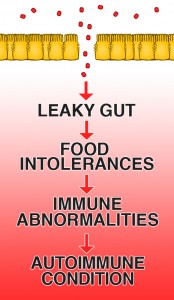
Think of the lining of your digestive tract like a net with extremely small holes in it – allowing only a select few substances to pass through it. Your gut lining acts as a barrier that keeps out harmful substances. When it erodes, those harmful substances pass through and do a great deal of damage to your body. The image below does a brilliant job of describing exactly what happens when one has a leaky gut.
Doctors-Clinic-omg-My.Gut.Is.Leaky

Looks scary, doesn’t it? Well, there’s no need to worry. There is a way to treat this issue, and you can return to great health. It just takes time, and a great deal of effort on your part to eat the correct foods and avoid the bad foods. Our doctors at Doctors Clinic Houston are going to go the full 10 yards to give you all the information you need to end the leaky gut madness.

Symptoms

Before we talk about the treatment, let’s focus on the symptoms. If you don’t have any of these symptoms, then the chances that you have leaky gut are infinitesimal. If you do, then its best that you become not only more vigilant, but more proactive in finding out what is wrong. The inimitable Ayn Rand once said, “The question isn’t who is going to let me; it’s who is going to stop me.” That is the mentality you need to accept and live by, if you want to combat this incredibly destructive health issue. You need to fight tooth and nail to get rid of it. And if that means reading this entire article, and then looking into the problem for another 4 or 5 hours, then it’ll definitely be worth the time.
The symptoms for leaky gut are the following:

  • Bloating
  • Thyroid conditions
  • Fatigue
  • Joint pain
  • Skin issues like rosacea and acne
  • Digestive problems
  • Headaches
  • Brain Fog

What Causes Leaky Gut?

The four main causes of leaky gut which include:

  • Poor diet
  • Chronic stress
  • Toxin overload
  • Bacterial imbalance

There are other causes, but these cover the most common ones. Finding out that you have leaky gut is scary, but knowing what causes can be its own anodyne, for you know that there is a cure!

The 4-Step Plan to Heal Leaky Gut

  1. REMOVE foods and factors that damage the gut
  2. REPLACE with healing foods
  3. REPAIR with specific supplements
  4. REBALANCE with probiotics

The foods you need to eat are the following:

  • Bone Broth
  • Raw Cultured Dairy
  • Fermented Vegetables
  • Coconut Products
  • Flaxseeds and Hempseeds

Eat these foods and you will well be on your way to recovering from such a pernicious health issue.

Strength Training for the Elderly

We tend to think that only the youth and virile need to lift weights and build muscle. We think that it’s what you need to do to look good. But we forget about how important strength training is to maintain a healthy heart and strong bones. Obviously, strength training strengthens the muscles – the biceps, the triceps, quads, and so on. Everyone knows that. But it does more than just help with muscle tone. It helps prevent osteoporosis and it also keeps the heart strong and running optimally. For this reason, our Houston doctors beseech the elderly to commit to a regular weight training routine.

The question arises: what kind of workout routine ought the elderly commit to? Low weight, high repetition workouts. On a daily basis. Contrary to popular belief, weight training becomes more important as one ages. It is incredibly important to keep in mind that by the time one reaches the age of seventy, his or her muscle mass will have decreased by twenty-five percent. A light walk around the park is not enough to make up for this degree of weakening. Rebuilding muscle is imperative to prevent injuries. And, as we mentioned, starting off with light weights, wherein one can do 20 or more repetitions, will be of great benefit.

Loss of bone mass is a common sign of aging. Weight bearing exercise, like resistance or strength training, can greatly combat brittle bone formation, even reversing the damage that has already been done. Put great emphasis on strengthening your legs, as without strong legs, your mobility will greatly be hampered. Our doctors at Doctors Clinic Houston highly recommend the following workout routine, on a daily basis. Start with the upper body and then move to the lower body. If you cannot do all of the workouts every day, aim to do them at least every other day. You will not get the necessary benefits of working out if you only do so sporadically.

  • Chest Press: minimum 20 reps
  • Bicep Curl: minimum 20 reps
  • Overhead Press: minimum 20 reps
  • Leg Press: minimum 20 reps
  • Core Exercises: until exhaustion

Ideally, you want to do each exercise until exhaustion. If you can go beyond 20 repetitions, then do not stop. Continue until you can no longer do another rep. That is the best way to build muscle – when you create tiny microtears in the muscle, provoking them to rebuild even stronger than before.

For the individuals who think physical exercise takes time away from mental exercise (reading, writing, and so on), studies have shown that exercise improves mental clarity, making a person’s mind both sharper and more focused. Think of physical exercise as an investment to not only keep your muscles, bones, and heart strong but your brain as well. Your body and brain will thank you for choosing to strength train.

Vitamin D: A Study On How It Prevents Breast Cancer

It has been said that optimizing one’s vitamin D levels can prevent up to sixteen different types of cancer from growing and developing. Doctors Clinic’s doctors in Houston have already made explicit the degree to which cancers that affect organs such as the pancrease, ovaries, testicles, and skin begin to vitiate when vitamin D doses are greatly increased. Just recently, the professionals at Doctors Clinic have noticed that patients with breast cancer start feeling stronger and healthier when they take in over 5,000 IUs of vitamin D.

Vitamin D Decreases Risk of Cancer by Over Seventy Percent

Prevention is always preferable to treatment. And when it comes to cancer, things are absolutely no different. Certainly, a great many cancer survivors are alive and kicking in the world thanks to treatment methods such as chemotherapy and even Simpson oil; though no doctor recommends that you totally rely on even the most cutting-edge treatment methodologies. None of them are fail-safe, and for this reason, it is best to focus on prevention rather than cure. A study in 2007 has shown that just raising one’s serum levels to forty ng/ml is enough to obviate the most acute forms of cancer – and breast cancer in particular.

What is most surprising of all, even to some of the most seasoned health and nutrition professionals around, is that raising one’s serum levels to forty ng/ml is not that difficult at all. It takes relatively little effort to get to said level, and fortunately, for women, it can be enough to keep breast canncer away. Regarding this particular 2007 study, there was a seventy-five percent reduction of incidence of cancers after only 5 years – a remarkable feat and one that ought to be celebrated all across the globe.

Vitamin D Destroys Breast Cancer Cells

The illustrious Dr. Ced Garland – the man around town at UCSD, who has remained among the most esteemed professors at the university’s cancner center – has made a connection between Vitamin D definiciency and the development of cancer. Mr. Ced says that in practically every single case for patients with breast cancer, there is a lack of vitamin D, which affects the structure of the all important epithelial cells. Essentially, these particular cells stick to one another by a sticky substance known as E-cadherin. E-cadherin provides structure to the cell. And we all know that withotu structure, nothing can be sustenable for any great length of time – whether we’re talking about man-made structures like buildings and skyscrapers or biological and natural phenomena at the cellular level. E-cadherin is mostly composed of vitamin D and calcium.

Without adequate vitamin D, that particular structure begins to call apart, and those cells do what they are programmed to do in order to survive – multiply. If this growth process spirals out of control, what results is cancer.

Daily Doses

Houston doctors recommend a daily dose of 8,000 IUs of vitamin D3 per day. It is important to stress that we are talking about D3, and not just vitamin D. Taking vitamin D3 is much safer than the synthetic D2 version, and going over the recommended dose of D3 per day doesn’t do as much harm as doing so with D2. The only thing to keep in mind is that it is important to also increase one’s intake of vitamin K2. Without vitamin K2, vitamin D can calcify, resulting in clogged arteries. Overall, though, it is an imperative to get one’s vitamin D levels checked. Doctors Clinic Houston offers extensive vitamin deficiency testing. A minor investment of time in choosing to get one’s blood taken and tested can go a long way toward understanding what the body is lacking and what it needs in order to optimize health.

Green Tea – Its Many Health Benefits

Green tea is without question among the healthiest beverages to date, with research displaying impressive health benefits not only for one’s heart, but for one’s bones, weight, vision, and even one’s brain. Anyone with an interest in improving his or her health, and specifically his or her brain health, green tea is definitely worth a consideration.

Green Tea Improves Brain Health

According to the Mercola Natural Health Center, an individual highly regarded in the eyes of Doctors Clinic Houston, a recent study of twelve virile volunteers, the participants receiving a beverage that contained just under 28 grams of green tea extract displayed an increased connectivity between the parietal and frontal cortex of the brain compared to those who drank a non-green tea beverage.

Researchers suggest that one’s cognitive functioning is strengthened if people consume pure green tea extract. And that is by far among the great benefits of tea – if you don’t particularly like it for its taste (or if you only drink it once in a blue moon), you can still get the health benefits by consuming it in supplemental extract form.

The Many Other Health Benefits of green Tea

It is not just your brain that gets these wondrous benefits from green tea. Below is a list of the other ways green tea improves ones health.

The Reduction Mortality; Chronic Inflammation

Empirical studies indicate that people who drink green tea also tend to live longer. Hear problems are reduced drastically. Research also makes the case that there are holistic benefits to consuming this wondrous herb, which include a lowering of blood pressure and chronic inflammation.

Heart Health

Dr. Mercola, health expert and founder of the Natural Health Center, states that green tea contributes to an improvement of blood flow and to the ability of one’s arteries to relax. In order to get these benefits, research suggests that a couple of cups of green tea each day may help prevent heart disease. Nowadays, just about every Houston doctor recommends a cup of green tea each day or so.

Type-2 Diabetes

A single study showed that people who consume around seven cups of green tea daily had a 29% lower risk of developing type two diabetes than individuals who consumed less than a single cup per week.

Vision Health

Catechins in green tea can also protect you against eye problems like glaucoma. Research has disinterred the fact that the compounds travel from your digestive system to the tissues of your eyes. During the study, the catechins found in green tea were absorbed into various parts of the eyes anywhere from 30 minutes to 12 hours after rats were given tea.

Cancer

Green tea components show a tendency to downregulate the expression of proteins involved in inflammation, cell signalization, cell motility, and angiogenesis, while an association between green tea intake and decreased risk of cancers (including ovarian and breast) has been reported.

Sugar: A Leading Promoter of Cancer & Heart Disease

toxic-sugar-300x223

More than 1.6 million new cancer cases are expected to be diagnosed in the United States of America this year – and over half a million are expected to die from the disease. Another 600,000 Americans die every single year due to heart disease – it being the number one cause of death among both males and females.

Regardless of the incredible technological advances over the past century, Western medicine still has no idea of how to stop the progression of these two diseases in their tracks.

It’s becoming more and more clear that many of the conventional strategies claiming to properly and effectively treat and prevent cancer and heart disease hold many flawed assumptions that do more harm than they do good.

The sad thing is that these conventional strategies actually fail to address the core of the problem: that a diet high in sugar and processed foods is the culprit.

For many years, saturated fats have been where physicians and nutrition experts were placing the blame. They thought that eating foods high in saturated fat would lead to clogged arteries, which would then lead to the inevitable heart problems. Now, more and more folks are beginning to realize that saturated fats are healthy, and necessary for optimal brain function.

What they have realized is that a diet high in sugar, and fructose in particular, is what leads to serious health problems – heart disease, cancer, and many others. Equipped with this pivotal information puts you in the driver’s seat when it comes to the prevention of these pernicious diseases.

So How Much Sugar Is in Your Diet?

So high sugar consumption deleteriously affects one’s health. But hold on a second, cutting out sugars is not the be all end all. Many food ingredients out there do even more damage than sugar, and the bad thing is that there are a few that are in over half of the boxed foods that you find in the grocery store. They all have funky, difficult to pronounce names. The word sugar isn’t appended to them to warn you of how unhealthy they are. Rather, it seems as though there is an attempt to obscure the truth from the general public, so that they do not know what they are eating. If they did, they would be able to make wiser, healthier choices and thus boycott the companies that pump out foods with harmful ingredients.

Hidden sugar, in the form of high fructose corn syrup is in just about every single processed food imaginable. You can even find it in stuff that you would generally consider to be the healthiest foods of all – like yogurt and certain juices. They are in just about every soda you can think of, and now, they are beginning to appear in just about every other bread or sauce that you buy from the store. The majority of the grains have this noxious corn syrup. Grain-based staples, like pancakes, muffins and cereals, have a bunch of sugar in them already (they quickly turn to sugar in your body). Now, adding high fructose corn syrup into the mix is just adding fuel to the fire.

Studies indicate that if you limit your sugar, you dramatically decrease your chances of developing cancer – and that includes breast and colon cancers. Those who want to optimize their health need to think long and hard before they make their next trip to the grocery store. Chances are, they are consuming far too much of both sugar and high fructose corn syrup.

Fructose Increases Cancer Risk

As we mentioned earlier, high fructose corn syrup is in just about every single soda out there. Many companies have attempted to conceal this fact by using a different name for the ingredient instead. Regardless, the body’s reaction to the exposure of such unhealthy stuff is going to be the same. DNA damage, altered cellular metabolism and inflammation are all symptoms that develop as a result of drinking too much soda.

Tumor cells thrive in glucose. This, by itself, confirms the old adage that sugar feeds cancer. Cells have the capacity to use fructose for cell division. A rapid and unmitigated growth of cells is what causes cancer. The tumors you see are a bunch of cells that have reproduced at a rate much faster than normal.

This by no means suggests that one ought to totally avoid fruits just because they are high in sugar as well. The benefits of fruit definitely outweigh any concerns regarding fructose. It is recommended not to juice fruits and to eat them whole. Fruits today are a great deal sweeter than they were in the past, and for that, should be consumed in moderation. The greatest problem, though, is the high fructose corn syrup that is in practically each and every one of the processed foods and drinks you see.

Don’t Forget the Exercise

Exercise actually does more than merely help you look thin and good. Controlling your blood-glucose and insulin levels can be an incredibly effective way of recovering from cancer. Exercise is a fantastic way of doing this. Of course, this is not the be all end all by any stretch of the imagination. But exercise is a big factor, if not in recovering from cancer, at the very least, preventing cancer. Folks who spend a great deal of time getting their heart rate up and running do seem to develop cancer much less than the inert who remain listless on a regular basis.

In short, maintaining a healthy weight and exercising on the regular creates an incredibly healthy feedback loop that makes certain that insulin and leptin levels are at an optimal level. Insulin and leptin resistance – mostly driven by not exercising and by eating a lot of refined sugars – are the underlying factors that result in pretty much the majority of chronic diseases.

1 2 3 4

Search

+