What is Stress?

18 Apr 2014 General Health


Unknown-2

Stress is not a useful term for scientists because it is such a highly subjective phenomenon that it defies definition. And if you can’t define stress, how can you possibly measure it? The term “stress”, as it is currently used was coined by Hans Selye in 1936, who defined it as “the non-specific response of the body to any demand for change”. Selye had noted in numerous experiments that laboratory animals subjected to acute but different noxious physical and emotional stimuli (blaring light, deafening noise, extremes of heat or cold, perpetual frustration) all exhibited the same pathologic changes of stomach ulcerations, shrinkage of lymphoid tissue and enlargement of the adrenals. He later demonstrated that persistent stress could cause these animals to develop various diseases similar to those seen in humans, such as heart attacks, stroke, kidney disease and rheumatoid arthritis. At the time, it was believed that most diseases were caused by specific but different pathogens. Tuberculosis was due to the tubercle bacillus, anthrax by the anthrax bacillus, syphilis by a spirochete, etc. What Selye proposed was just the opposite, namely that many different insults could cause the same disease, not only in animals, but in humans as well.


Selye’s theories attracted considerable attention and stress soon became a popular buzzword that completely ignored Selye’s original definition. Some people used stress to refer to an overbearing or bad boss or some other unpleasant situation they were subjected to. For many, stress was their reaction to this in the form of chest pain, heartburn, headache or palpitations. Others used stress to refer to what they perceived as the end result of these repeated responses, such as an ulcer or heart attack. Many scientists complained about this confusion and one physician concluded in a 1951 issue of the British Medical Journal that, “Stress in addition to being itself, was also the cause of itself, and the result of itself.”


Unfortunately, Selye was not aware that stress had been used for centuries in physics to explain elasticity, the property of a material that allows it to resume its original size and shape after having been compressed or stretched by an external force. As expressed in Hooke’s Law of 1658, the magnitude of an external force, or stress, produces a proportional amount of deformation, or strain, in a malleable metal. This created even more confusion when his research had to be translated into foreign languages. There was no suitable word or phrase that could convey what he meant, since he was really describing strain. In 1946, when he was asked to give an address at the prestigious Collège de France, the academicians responsible for maintaining the purity of the French language struggled with this problem for several days, and subsequently decided that a new word would have to be created. Apparently, the male chauvinists prevailed, and le stress was born, quickly followed by el stress, il stress, lo stress, der stress in other European languages, and similar neologisms in Russian, Japanese, Chinese and Arabic. Stress is one of the very few words you will see preserved in English in these and other languages that do not use the Roman alphabet.


Because it was apparent that most people viewed stress as some unpleasant threat, Selye subsequently had to create a new word, stressor, to distinguish stimulus from response. Stress was generally considered as being synonymous with distress and dictionaries defined it as “physical, mental, or emotional strain or tension” or “a condition or feeling experienced when a person perceives that demands exceed the personal and social resources the individual is able to mobilize.” Thus, stress was put in a negative light and its positive effects ignored. However, stress can be helpful and good when it motivates people to accomplish more.


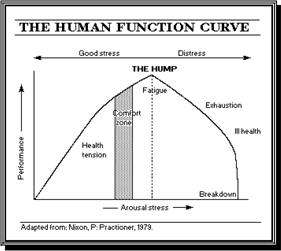
As illustrated to the left, increased stress results in increased productivity – up to a point, after which things go rapidly downhill. However, that point or peak differs for each of us, so you need to be sensitive to the early warning symptoms and signs that suggest a stress overload is starting to push you over the hump. Such signals also differ for each of us and can be so subtle that they are often ignored until it is too late. Not infrequently, others are aware that you may be headed for trouble before you are.


Any definition of stress should therefore also include good stress, or what Selye called eustress. For example, winning a race or election can be just as stressful as losing, or more so. A passionate kiss and contemplating what might follow is stressful, but hardly the same as having a root canal procedure.


Selye struggled unsuccessfully all his life to find a satisfactory definition of stress. In attempting to extrapolate his animal studies to humans so that people would understand what he meant, he redefined stress as “The rate of wear and tear on the body”. This is actually a pretty good description of biological aging so it is not surprising that increased stress can accelerate many aspects of the aging process. In his later years, when asked to define stress, he told reporters, “Everyone knows what stress is, but nobody really knows.”


As noted, stress is difficult to define because it is so different for each of us. A good example is afforded by observing passengers on a steep roller coaster ride. Some are hunched down in the back seats, eyes shut, jaws clenched and white knuckled with an iron grip on the retaining bar. They can’t wait for the ride in the torture chamber to end so they can get back on solid ground and scamper away. But up front are the wide-eyed thrill seekers, yelling and relishing each steep plunge who race to get on the very next ride. And in between you may find a few with an air of nonchalance that borders on boredom. So, was the roller coaster ride stressful?


The roller coaster analogy is useful in explaining why the same stressor can differ so much for each of us. What distinguished the passengers in the back from those up front was the sense of control they had over the event. While neither group had any more or less control their perceptions and expectations were quite different. Many times we create our own stress because of faulty perceptions you can learn to correct. You can teach people to move from the back of the roller coaster to the front, and, as Eleanor Roosevelt noted, nobody can make you feel inferior without your consent. While everyone can’t agree on a definition of stress, all of our experimental and clinical research confirms that the sense of having little or no control is always distressful – and that’s what stress is all about.


– See more at: http://www.stress.org/what-is-stress/#sthash.hrwk9Ezl.dpuf

Easy Nutrition Label Guide

nutrition_veggieword_CFFH-1024x2181

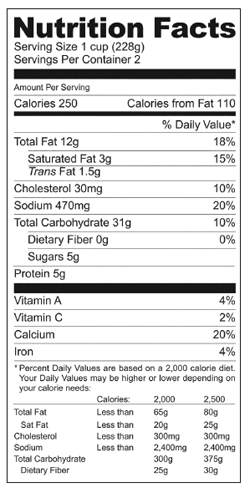
Start with the Serving SizeNutritionFactsPanel

  • Look here for both the serving size (the amount for one serving) and the number of servings in the package.
  • Compare your portion size (the amount you actually eat) to the serving size listed on the panel. If the serving size is one cup and you eat two cups, you are getting twice the calories, fat and other nutrients listed on the label.

Check Out the Total Calories and Fat

  • Find out how many calories are in a single serving and the number of calories from fat. It’s smart to cut back on calories and fat if you are watching your weight.

Let the Percent Daily Values Be Your Guide

Use percent Daily Values (DV) to help evaluate how a particular food fits into your daily meal plan:

  • Daily Values are average levels of nutrients for a person eating 2,000 calories a day. A food item with a 5 percent DV of fat provides 5 percent of the total fat that a person consuming 2,000 calories a day should eat.
  • Percent DV are for the entire day, not just one meal or snack
  • You may need more or less than 2,000 calories per day. For some nutrients you may need more or less than 100 percent DV.

The High and Low of Daily Values

  • 5 percent or less is low. Aim low in total fat, saturated fat, trans fat, cholesterol and sodium.
  • 20 percent or more is high. Aim high in vitamins, minerals and fiber.

Limit Fat, Cholesterol and Sodium

Eating less fat, cholesterol and sodium may help reduce your risk for heart disease, high blood pressure and cancer.

  • Total fat includes saturated, polyunsaturated, monounsaturated and trans fat. Limit to 100 percent DV or less per day.
  • Saturated fat and trans fat are linked to an increased risk of heart disease.
  • High levels of sodium can add up to high blood pressure.
  • Remember to aim for low percentage DV of these nutrients.

Get Enough Vitamins, Minerals and Fiber

  • Eat more fiber, vitamins A and C, calcium and iron to maintain good health and help reduce your risk of certain health problems such as osteoporosis and anemia.
  • Choose more fruits and vegetables to get more of these nutrients.
  • Remember to aim high for percentage DV of these nutrients.

Additional Nutrients

You know about fat and calories, but it is important to also know the additional nutrients on the Nutrition Facts Panel.

  • ProteinMost Americans eat more protein than they need, so a percentage Daily Value is not required on the label. Eat moderate portions of lean meat, poultry, fish, eggs, low-fat milk, yogurt and cheese, plus beans, peanut butter and nuts.
  • CarbohydratesThere are three types of carbohydrates: sugars, starches and fiber. Eat whole-grain breads, cereals, rice and pasta plus fruits and vegetables.
  • SugarsSimple carbohydrates or sugars occur naturally in foods such as fruit juice (fructose) or come from refined sources such as table sugar (sucrose) or corn syrup.

Check the Ingredient List

Foods with more than one ingredient must have an ingredient list on the label. Ingredients are listed in descending order by weight. Those in the largest amounts are listed first. This information is particularly helpful to individuals with food sensitivities, those who wish to avoid pork or shellfish or limit added sugars or people who prefer vegetarian eating.

food-pyramid-(1)

Get Back in The Swing of Spring


Birds chirping, trees blooming and feet on the pavement all signal the arrival of spring. However, hitting the great outdoors for a 5K or fun run involves more than just lacing up your sneakers and programming the perfect playlist. After a long winter slumber, these five simple steps will get you on your feet again the safe and healthy way.

Running_Tips_250


Go Eat

Starving yourself should never be part of an exercise regimen, but eating right should. Fuel up with whole-wheat breads, pastas and brown rice two hours before your workout. “Whole grains … are going to give you a longer lasting energy to get through your runs,” says Academy of Nutrition and Dietetics Spokesperson Amy Jamieson-Petonic, MEd, RD, CSSD, LD, LMT. “Even half a whole-grain bagel a half hour before you run could help with that.”

Foods to avoid include anything high in sugar like jams and jellies, cookies, cakes, pies and doughnuts, says Jamieson-Petonic. “They tend to give you a quick burst of energy, but then your blood sugar bottoms out,” she says. Healthy substitutes include energy and granola bars, low-fat or fat-free yogurt and fruit smoothies, peanut butter on a bagel thin, and chocolate milk. Foods that may help reduce inflammation such as salmon, tuna and nuts are also good choices.

Go Drink

“Everyone should really be going into a workout hydrated,” says USA Triathlon Coach and professional triathlete Kim Schwabenbauer, RD, LDN. “It prevents muscle tears and it helps you feel better during the workout.” Schwabenbauer recommends drinking fluids throughout the day and definitely within the hour before you workout. Both Schwabenbauer and Jamieson-Petonic agree that water is great if the workout is under 60 minutes, but recommend a sports or energy drink for runs more than an hour.

Go Stretch

“The warm up and cool down are definitely important components of the workout and they should never be skipped,” says Schwabenbauer, who advises ditching static exercises such as grabbing ankles and stretching quads. “Static stretching is really a way of the past,” she says. Instead, try squats, forward lunges and the soldier walk. This is a stretch in which you stand in place with your arms out in front and try and kick your hands, all while keeping your legs elongated.

Go Slow

That race you ran last summer was a long time ago. Consider easing back into your routine if it’s been a while since you’ve run hardcore. “Don’t go out for the first run and think, ‘Today, I’m going to run three miles,'” says Schwabenbauer. “[People] run really hard and then they’re off the next four days because they’re so sore and tired.” Instead, Schwabenbauer advises picking a distance and then increasing gradually by 30-second intervals over time.

Go Rest

When you exercise you’re causing tiny microscopic tears in muscle fiber. Those muscles need time to build themselves back up. “It’s important that we allow our muscles a chance to recover and heal,” says Jamieson-Petonic, who advises either a day of rest or cross training for diehard workout junkies. “Get on a bicycle, get in a pool, do some strength training or core work such as yoga or other types of exercise, so you can give those muscles a chance to heal.”

Unknown

How Your KIDNEYS Work

HOW YOUR KIDNEYS WORK
strategicplan_660

Why Are the Kidneys So Important?

Most people know that a major function of the kidneys is to remove waste products and excess fluid from the body. These waste products and excess fluid are removed through the urine. The production of urine involves highly complex steps of excretion and re-absorption. This process is necessary to maintain a stable balance of body chemicals.

The critical regulation of the body’s salt, potassium and acid content is performed by the kidneys. The kidneys also produce hormones that affect the function of other organs. For example, a hormone produced by the kidneys stimulates red blood cell production. Other hormones produced by the kidneys help regulate blood pressure and control calcium metabolism.

The kidneys are powerful chemical factories that perform the following functions:

  • remove waste products from the body
  • remove drugs from the body
  • balance the body’s fluids
  • release hormones that regulate blood pressure
  • produce an active form of vitamin D that promotes strong, healthy bones
  • control the production of red blood cells

Below you will find more information about the kidneys and the vital role they play in keeping your body functioning.

Where Are the Kidneys and How Do They Function?

There are two kidneys, each about the size of a fist, located on either side of the spine at the lowest level of the rib cage. Each kidney contains up to a million functioning units called nephrons. A nephron consists of a filtering unit of tiny blood vessels called a glomerulus attached to a tubule. When blood enters the glomerulus, it is filtered and the remaining fluid then passes along the tubule. In the tubule, chemicals and water are either added to or removed from this filtered fluid according to the body’s needs, the final product being the urine we excrete.

The kidneys perform their life-sustaining job of filtering and returning to the bloodstream about 200 quarts of fluid every 24 hours. About two quarts are removed from the body in the form of urine, and about 198 quarts are recovered. The urine we excrete has been stored in the bladder for anywhere from 1 to 8 hours.

What Are Some of the Causes of Chronic Kidney Disease?

Chronic kidney disease is defined as having some type of kidney abnormality, or “marker”, such as protein in the urine and having decreased kidney function for three months or longer.

There are many causes of chronic kidney disease. The kidneys may be affected by diseases such as diabetes and high blood pressure. Some kidney conditions are inherited (run in families).

Others are congenital; that is, individuals may be born with an abnormality that can affect their kidneys. The following are some of the most common types and causes of kidney damage.

Diabetes is a disease in which your body does not make enough insulin or cannot use normal amounts of insulin properly. This results in a high blood sugar level, which can cause problems in many parts of your body. Diabetes is the leading cause of kidney disease.

High blood pressure (also known as hypertension) is another common cause of kidney disease and other complications such as heart attacks and strokes. High blood pressure occurs when the force of blood against your artery walls increases. When high blood pressure is controlled, the risk of complications such as chronic kidney disease is decreased.

Glomerulonephritis is a disease that causes inflammation of the kidney’s tiny filtering units called the glomeruli. Glomerulonephritis may happen suddenly, for example, after a strep throat, and the individual may get well again.However, the disease may develop slowly over several years and it may cause progressive loss of kidney function.

Polycystic kidney disease is the most common inherited kidney disease. It is characterized by the formation of kidney cysts that enlarge over time and may cause serious kidney damage and even kidney failure. Other inherited diseases that affect the kidneys include Alport’s Syndrome,primary hyperoxaluria and cystinuria.

Kidney stones are very common, and when they pass, they may cause severe pain in your back and side. There are many possible causes of kidney stones, including an inherited disorder that causes too much calcium to be absorbed from foods and urinary tract infections or obstructions. Sometimes, medications and diet can help to prevent recurrent stone formation. In cases where stones are too large to pass, treatments may be done to remove the stones or break them down into small pieces that can pass out of the body.

Urinary tract infections occur when germs enter the urinary tract and cause symptoms such as pain and/or burning during urination and more frequent need to urinate. These infections most often affect the bladder, but they sometimes spread to the kidneys, and they may cause fever and pain in your back.

Congenital diseases may also affect the kidneys. These usually involve some problem that occurs in the urinary tract when a baby is developing in its mother’s womb. One of the most common occurs when a valve-like mechanism between the bladder and ureter (urine tube) fails to work properly and allows urine to back up (reflux) to the kidneys, causing infections and possible kidney damage.

Drugs and toxins can also cause kidney problems. Using large numbers of over-the-counter pain relievers for a long time may be harmful to the kidneys. Certain other medications, toxins, pesticides and “street” drugs such as heroin and crack can also cause kidney damage

How is Chronic Kidney Disease Detected?

Early detection and treatment of chronic kidney disease are the keys to keeping kidney disease from progressing to kidney failure. Some simple tests can be done to detect early kidney disease. They are:

  1. Blood pressure measurement
  2. A test for protein in the urine. An excess amount of protein in your urine may mean your kidney’s filtering units have been damaged by disease. One positive result could be due to fever or heavy exercise, so your doctor will want to confirm your test over several weeks.
  3. A test for blood creatinine. Your doctor should use your results, along with your age, race, gender and other factors, to calculate your glomerular filtration rate (GFR). Your GFR tells how much kidney function you have. To access the GFR calculator, click here.

It is especially important that people who have an increased risk for chronic kidney disease have these tests. You may have an increased risk for kidney disease if you:

  • are older
  • have diabetes
  • have high blood pressure
  • have a family member who has chronic kidney disease
  • are an African American, Hispanic American, Asians and Pacific Islander or American Indian.

If you are in one of these groups or think you may have an increased risk for kidney disease, ask your doctor about getting tested.

Can Kidney Disease Be Successfully Treated?

Many kidney diseases can be treated successfully. Careful control of diseases like diabetes and high blood pressure can help prevent kidney disease or keep it from getting worse. Kidney stones and urinary tract infections can usually be treated successfully. Unfortunately, the exact causes of some kidney diseases are still unknown, and specific treatments are not yet available for them. Sometimes, chronic kidney disease may progress to kidney failure, requiring dialysis or kidney transplantation. Treating high blood pressure with special medications called angiotensin converting enzyme (ACE) inhibitors often helps to slow the progression of chronic kidney disease. A great deal of research is being done to find more effective treatment for all conditions that can cause chronic kidney disease.

How is Kidney Failure Treated?

Kidney failure may be treated with hemodialysis, peritoneal dialysis or kidney transplantation. Treatment with hemodialysis (the artificial kidney) may be performed at a dialysis unit or at home. Hemodialysis treatments are usually performed three times a week. Peritoneal dialysis is generally done daily at home. Continuous Cycling Peritoneal Dialysis requires the use of a machine while Continuous Ambulatory Peritoneal Dialysis does not. A kidney specialist can explain the different approaches and help individual patients make the best treatment choices for themselves and their families.

Kidney transplants have high success rates. The kidney may come from someone who died or from a living donor who may be a relative, friend or possibly a stranger, who donates a kidney to anyone in need of a transplant.

What Are the Warning Signs of Kidney Disease?

Kidney disease usually affects both kidneys. If the kidneys’ ability to filter the blood is seriously damaged by disease, wastes and excess fluid may build up in the body. Although many forms of kidney disease do not produce symptoms until late in the course of the disease, there are six warning signs of kidney disease:

  1. High blood pressure.
  2. Blood and/or protein in the urine.
  3. A creatinine and Blood Urea Nitrogen (BUN) blood test, outside the normal range. BUN and creatinine are waste that build up in your blood when your kidney function is reduced.
  4. A glomerular filtration rate (GFR) less than 60. GFR is a measure of kidney function.
  5. More frequent urination, particularly at night; difficult or painful urination.
  6. Puffiness around eyes, swelling of hands and feet.

(Source: Kidneys.Org)
Maintaining a Goal Weight

Reached your goal weight? What to do next? New diet or dame routine? Read what the experts say below:

weight-loss-maintenance

The question: After you’ve slimmed down, should you use a different strategy for maintaining weight loss? Or will the same steps that help you drop pounds in the first place still work?

The expert: James O. Hill, Ph.D., executive director of the Anschutz Health and Wellness Center at the University of Colorado and author of State of Slim

The answer: Actually, your game plan for losing weight should be totally different from your game plan for keeping it off. When you’re in weight-loss mode, it’s a temporary situation primarily driven by food restriction (which is why it’s so much easier to lose weight through diet than exercise). “You can do things for three months that you can’t do forever,” says Hill.

When it comes to maintaining your weight, though, research indicates that exercise is the single biggest factor in predicting who’s going to prevent the weight from creeping back on, says Hill. “Keeping weight off is about delveoping new habits and rituals and routines,” he says. “It becomes much more important to look at long-term behavior change for maintenance.”

To kickstart your own lasting healthy habits, check out the 10 eating habits of perpetually fit people and read up on how to stick to your workout for good

Source: ABC NEWS – Health

Consumer Awareness for Health Care

For the most part, Americans are champ consumers. But we’re not such good shoppers when it comes to our own health. Studies show that Americans spend more time researching car purchases and new appliances than they do choosing doctors and health plans.

We’re not even sure we have options. Over half of all Americans said in a recent survey they did not feel confident that they could reduce the cost of health care by shopping around. And many of us are shy about negotiating with our doctors, or asking if an expensive test is really necessary.

Meanwhile, escalating health care costs have burdened both employees and employers. The average cost of a visit to the doctor is about $199; a visit to the ER costs about $922, according to AHRQ. About 25% of those visits are unnecessary. You can imagine how many billions of dollars this costs everyone every year.

You can start researching NOW to get coverage before the OPEN ENROLLMENT IS UP!!! 

APPLICATION DEADLINE FOR COVERAGE STARTING APRIL 1st, 2014 IS MARCH 15!

health-insurance-marketplace-highlight  

OPEN ENROLLMENT ENDS MARCH 31ST

New Blood Pressure Facts Revealed

New science is changing the way people 50 and older judge their blood pressure, and a slew of new studies on foods and hypertension suggest it may be easier than you thought to reduce high blood pressure.

For adults under 65, it’s that upper number in your blood pressure reading that may be the best indicator of future heart problems or even premature death. A normal reading is around 120/80. If that first number is 140 or higher, you have reason for concern.

For those 65 and older, however, it’s a trickier situation. Readings may vary more and doctors need to be careful in prescribing blood pressure medication for older patients.

One safe, effective way to decrease blood pressure for all age groups is to eat foods that work naturally to dilate blood vessels so the heart doesn’t have to work so hard.

Eat more of these six fabulous foods for an easy, delicious way to help lower your blood pressure numbers:

420-six-foods-that-lower-blood-pressure-nl.imgcache.rev1319216607551

Holiday Health Facts

It’s that time of year again when we enjoy festive meals with family and friends, deck our halls with colorful decorations and listen to squeals of delight as our children open their brightly-wrapped presents.  To help ensure your kids have fun and stay safe this holiday, here are a few tips to remember.

Hard Facts

In 2012, 3,270 children 19 and under were seen in emergency rooms for injuries caused by nonelectric holiday decorations, like broken ornaments. In 2011, an estimated 193,200 children were treated in an emergency room for a toy-related injury. And in the same year, an estimated 136,314 children ages 19 and under were injured due to a fire or burn.

Top Tips

  • Natural trees look beautiful and smell great, but if they’re not watered regularly, needles can dry out and pose a potential fire hazard. Make sure your tree has plenty of water by checking it regularly.
  • Keep holiday candles at least 12 inches away from anything that can burn, and don’t forget to blow them out when you leave the room or before you go to sleep.
  • Consider your child’s age when purchasing a toy or game this holiday season. It’s worth a second to read the instructions to make sure the gift is just right
  • Keep a special eye on small pieces, including button batteries that may be included in electronic toys. While these kinds of games are great for older kids, they can pose a potential danger for younger, curious siblings.
  • Kids love to reach, so to prevent burns from hot holiday food or liquid spills, simply use the back burner of your stove and turn pot handles away from the edge.
  • Kids are curious and will want to play with the ornaments on the tree, so you might as well prepare. Move the ornaments that are breakable or have metal hooks towards the top of the tree. That makes room at the bottom for the ones that are safer for young kids.

– See more at: http://www.safekids.org/holidays#sthash.OF7vGJlU.dpuf

HOLIDAY TOY SAFETY!

TOY SAFETY TIPS

Find the Perfect Toy for the Right Age

  • Consider your child’s age when purchasing a toy or game. It’s worth a second to read the instructions and warning labels to make sure it’s just right for your child.
  • Before you’ve settled on the perfect toy, check to make sure there aren’t any small parts or other potential choking hazards.

Don’t Forget a Helmet for Riding Toys

  • If your children have their hearts set on a new bike, skateboard, scooter or other riding equipment, be sure to include a helmet to keep them safe while they’re having fun.
  • Learn more bike safety tips and watch our helmet safety video.

Store Toys After Play

  • After play time is over, use a bin or container to store toys for next time. Make sure there are no holes or hinges that could catch little fingers.

Sign Up to Receive Product Recalls

  • Safe Kids compiles product recalls specific to children and sends twice-monthly e-mail alerts for recent recalls. Sign-up for the latest recall information.
  • Go to www.recalls.gov for additional information about product recalls related to kids.


– See more at: http://www.safekids.org/tip/toy-safety-tips#sthash.M7jgiS1t.dpuf

How Movember Got started in Australia by The Co-Founder of Movember!

19 Nov 2013 General Health

Adam Garone: Healthier men, one moustache at a time!

Garone-1


Adam Garone is co-founder of Movember – the month-long fundraising event held every November where men grow a moustache (a ‘mo’), raising awareness and money for men’s health along the way.
Movember has grown from a group of 30 mates, who wanted to bring the mo back into fashion and also raise money for a good cause, into a world-wide phenomenon. In 2007, some 96,000 ‘Mo Bro’s’ across Australia joined the campaign, raising $14 million dollars for health charities, the Prostate Cancer Foundation of Australia and beyondblue – the national depression initiative.
“We want to fundamentally change the way men think, talk and act about their health”

“We want to fundamentally change the way men think, talk and act about their health”, explains Adam. “The mo is a conversation starter; a vehicle for men to talk about their health. We get lots of emails from guys saying that they were suffering from depression and by growing a mo they were able to speak about it.” It’s a clever campaign which has struck a chord, not only in Australia, but also in New Zealand, the UK, Canada, Spain and other countries around the world.​

Last year Movember launched internationally into New Zealand. It raised over $850,000 for the New Zealand Prostate Council- the highest amount ever raised for the organisation by $835,000. Thrilled with the results, Adam and his team spent the best part of 2007 gearing up for international launches in the US, UK and Spain.

“We never anticipated it would have such a following in Australia, let alone globally”, says Adam, who is now based in the US as Movember’s North America Operations Director.

Adam began his career in the Australian Army before completing his Master of Marketing at MBS. After graduating, he spent seven years in the e-commerce industry, managing product development and online marketing for Vodafone and other Australian companies.

Though the original idea for Movember was sparked by a conversation among a group of friends who decided to ‘bring the mo back to its former glory’, Adam – a health and fitness buff – also recognised a gap in the market for men’s health. “While there are a lot of events for women’s health there was previously none for men’s.”
Furthermore, Australian charities hadn’t traditionally used the internet to raise money, which is where Adam’s online expertise came into play: Movember’s registration and sponsorship is all managed online, making it easy for Mo Bros to sign-up, and equally simple for sponsors to support the campaign.

Movember culminates in end-of-month parties where Mo Bros and Mo Sisters (women who encourage their friends and partners to support the cause) celebrate the end of the campaign and crown the Man of Movember.

-Story courtesy of www.mbs.edu


1 2 3 4 5 7

Search

+